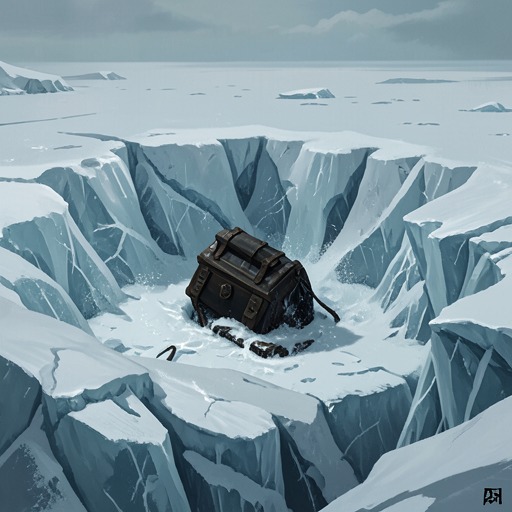
Bioluminescent plankton anomaly in the meteorite pit
Deception PointThe Bioluminescent plankton anomaly in the meteorite pit begins as a startling glow and becomes a test of the discovery’s credibility. In the darkened dome, Rachel Sexton and Corky Marlinson find Michael Tolland at the extraction shaft, where blue-green specks shimmer on the water. Tolland identifies the organisms as plankton, but their presence in meltwater trapped beneath a glacier makes the scene more than an oddity: it contradicts the account of an intact, freshwater ice mass and prompts a direct scientific check.
The Glow in the Extraction Pit
Rachel Sexton and Corky Marlinson cross the darkened NASA habisphere toward the extraction pit after noticing Michael Tolland standing near the shaft. Their approach starts in the familiar joking register of the team’s conversation, but Corky’s levity falls away when he looks into the water. The surface is flecked with blue-green points of light, pulsing like neon dust. What first appears beautiful is also out of place.
Tolland tests the effect by tossing a shard of ice into the pool. The impact triggers a sudden green flare, confirming that the light is coming from the water rather than from an object on its surface. He recognizes the phenomenon as bioluminescence and says the visible organisms are flagellates. When he gives a more specific provisional identification, he describes them as bioluminescent plankton from the phylum Pyrrophyta, commonly found in the Arctic Ocean. He qualifies that judgment: without a microscope, he cannot be certain.
The decisive problem is not that bioluminescent plankton exist in Arctic waters. It is that these organisms appear in an extraction shaft fed by glacial melt. Tolland points out that the meteorite was buried in glacial ice formed from snowfall, while the water in the pit is melt from ice said to have been frozen for three centuries. The luminous pool therefore creates a pointed question about how ocean organisms could have entered a freshwater glacier.
Testing the Contradiction
Norah Mangor rejects the anomaly at first. She insists that her own measurements and NASA’s findings show the glacier to be solid, without cracks, and resents having her core data challenged by what she regards as speculation. Rather than accept the observation or dismiss it outright, she sets out to test the water herself, intending to establish that it contains no saltwater plankton, living or dead.
Using a sterile pipette attached to a string, Norah draws a sample from the melt pool. She places several drops in a small refractometer and checks the reading against the light coming through the dome’s oculus. The result unsettles her: the instrument registers three percent brine. She initially suspects the refractometer is faulty because the glacier is supposed to be a snowpack of pure freshwater, with no salt.
Norah then carries the sample to a microscope. Her examination identifies G. polyhedra, a plankton commonly encountered by glaciologists in ocean water beneath ice shelves. The organisms are dead; Norah reasons that they could not have survived long in water containing three percent brine. Her results establish two linked facts rather than resolving the contradiction: the pool contains salt, and it contains a recognizable marine plankton, even though it is supposed to be glacial melt.
From Visual Mystery to Evidentiary Problem
The sequence turns on a shift in what the water means. At first, the pulsing light is a striking visual interruption in the extraction operation. Tolland’s recognition gives it a natural explanation as bioluminescent plankton, but that explanation sharpens the mystery instead of closing it. Once Norah’s measurements confirm brine and dead G. polyhedra, the anomaly becomes a material inconsistency that can be examined and disputed.
That distinction matters to the larger investigation. Rachel recognizes that the paradox appears small beside the extraordinary claims surrounding the meteorite, but her experience as an intelligence analyst has taught her that larger theories can collapse over smaller discrepancies. The sample is concrete, repeatable evidence: the refractometer produces a brine reading, and microscopy identifies organisms associated with marine environments. The discovery’s public importance cannot make those results disappear, nor do they by themselves explain how the organisms got into the pit.
Norah and Tolland approach the anomaly from different professional starting points. Norah defends the glacier’s measured integrity and initially treats the result as an instrument problem; Tolland takes the incongruity seriously because the known source of the organisms does not fit the claimed environment. Their exchange makes scientific credibility depend not only on a striking observation, but also on sampling, measurement, identification, and a willingness to confront results that resist the established account.
Political Stakes and Narrative Function
The anomaly sits within a discovery whose evidence has been manipulated. Later, William Pickering tells Rachel that the meteorite is not authentic and that the information she has sent from the ship could make the White House and NASA appear complicit if released. He says the President and NASA believe the meteorite is genuine and know nothing of the deception. Pickering also explains that Lawrence Ekstrom’s role was limited to persuading the PODS mission supervisor to lie about the anomaly-detection software, a separate act that Ekstrom would have regretted once the meteorite drew scrutiny. This later disclosure does not make the plankton itself a complete explanation of the hoax; it places the pit’s contradiction within a wider pattern in which anomalies, technical claims, and institutional accounts carry political consequences.
The episode also sits against the background of the PODS anomaly-detection software failure. Chris Harper explains that the software was intended to search large areas of Arctic data for departures from normal ice density, first to locate soft spots relevant to global warming and also to flag other density anomalies. Its failure and the subsequent misrepresentation of it provide a separate point of tension between what the technology was supposed to establish and what officials said had happened. The plankton does not prove how the meteorite was planted, but it reinforces the story’s insistence that a celebrated discovery must withstand scrutiny at the level of its physical evidence.
The scene’s progression—from a luminous surface, to Tolland’s identification, to Norah’s pipette and microscope—makes observation a small but consequential counterweight to authority. The water does not speak for itself: the light must be interpreted, the salt measured, and the organisms identified. Yet each check makes the mismatch harder to wave away. In the extraction pit, the apparent wonder of the find meets the discipline of verification, and the discovery’s credibility becomes vulnerable to the details beneath its surface.